Skip to content
All Up Literacy
  • Teaching Articles
  • Start Here
  • ShopExpand
    • Online Store
    • TPT Shop
    • Courses
    • My Account
    • Cart
  • Courses
  • Home Support
All Up Literacy

What do you want to learn more about?

Consonants & Vowels SYLLABLE TYPES Syllable Division Spelling Rules & Patterns Sight Words READING Teaching Tools & Strategies Videos

  • Possessive Rules

    You’re in Possession of Orton Gillingham Possessive Rules

    Possessive rules can be easy, but can also get a little tricky when we move beyond just adding ‘s. Possessive Rules are all about ownership and can be narrowed down to a couple of categories: singular and plural. Singular Possessive Rule Singular Possessive Rule is to show ownership for a singular owner, add ‘s to…

    Read More You’re in Possession of Orton Gillingham Possessive RulesContinue

  • Plural Rules: 5 Simple Rules Every Student Should Know
    Plural Rules | Spelling | Spelling Rules & Patterns

    Plural Rules: 5 Simple Rules Every Student Should Know

    Without even thinking about it, we make words plural every day. We might go to one grocery store or visit several stores. Most of the time, making a word plural is as simple as adding -s. But what happens when the word doesn’t follow that pattern? Why do we write watches, stories, leaves, or children…

    Read More Plural Rules: 5 Simple Rules Every Student Should KnowContinue

  • Spelling Rules & Patterns

    The IE/EI Rule Yields Receipt

    There is a basic rule about IE/EI, but there are also many exceptions to the rule that make it difficult to learn and teach this concept. However, getting a basic understanding of the rule can level the field for spelling and reading. This rule is usually for 4th grade and above. First, the rule says…

    Read More The IE/EI Rule Yields ReceiptContinue

  • Suffix Rules

    I’m Seeing Double – 1-1-1 Doubling Rule Explained

    Continuing with Suffix Rules, the first one I will go in depth on is the 1-1-1 Doubling Rule. The grade level this rule corresponds with is 2nd through 12th. Before teaching this rule, one should know: What a suffix is That some suffixes begin with vowels and some with consonants The difference between one and…

    Read More I’m Seeing Double – 1-1-1 Doubling Rule ExplainedContinue

  • Prefixes/Suffixes | Suffix Rules

    Illustrations of Suffix Rules, An Overview

    Continuing with Suffixes, today I will create an overview of suffix rules. The three suffix rules are: 1-1-1 Doubling Rule, E Drop Rule and the Y-Changing Rule. I will do an overview today, but go in depth in my next posts. 1-1-1 Doubling rule is: 1 syllable words ending in 1 consonant after 1 vowel,…

    Read More Illustrations of Suffix Rules, An OverviewContinue

  • How to Teach Word Endings So Students Actually Notice Them (A Clear Approach to Suffixes)
    Prefixes/Suffixes | Suffix Rules | Syllable Division

    How to Teach Word Endings So Students Actually Notice Them (A Clear Approach to Suffixes)

    As a kid, when I learned suffixes, I don’t recall getting a lot of reasoning behind the topic. But, knowing what I know now, I can’t imagine teaching them any other way than how we teach in structured literacy. Today, I want to answer: How do suffixes fit into a cumulative Orton-Gillingham lesson? Because in…

    Read More How to Teach Word Endings So Students Actually Notice Them (A Clear Approach to Suffixes)Continue

  • Consonants & Vowels | Spelling Rules & Patterns | Vowel Teams

    Spelling Vowel Sounds: What Music They Make

    In my last post I talked about how to spell consonants. This week, we will cover how to spell vowels. It is important to note that when I say “spell” consonants and vowels I am talking about how letters can make more than one sound. For example, a makes a long and short sound, as…

    Read More Spelling Vowel Sounds: What Music They MakeContinue

  • How to Teach Consonant Spelling Sounds in Orton Gillingham
    Consonants & Vowels | Reading | Spelling Rules & Patterns

    How to Teach Consonant Spelling Sounds in Orton Gillingham

    Often in phonics, we talk about letters and the sounds they make. For example, the letter d says /d/ as in dog. That’s familiar and expected. What I had never been taught before learning Orton Gillingham, however, was how to spell a sound. This concept—spelling sounds versus reading sounds—is a powerful (and overlooked) lesson in…

    Read More How to Teach Consonant Spelling Sounds in Orton GillinghamContinue

  • Short Vowel Rules

    Short Vowel Rule Overview: FLOSS, Pitch, Judge, Stack

    My most recent posts covered the Short Vowel Rules in Orton Gillingham. Today I would like to give an overview of all four of these rules. I will also provide a practice worksheet and a quiz on these rules. Now that you have seen all four rules, grouping them together as “Short Vowel Rules” should…

    Read More Short Vowel Rule Overview: FLOSS, Pitch, Judge, StackContinue

  • Short Vowel Rules

    Short Vowel Rule: “CH” Rule – An Important Batch of Words

    This week we will cover the last of the Short Vowel Rules in Orton Gillingham. So far, we have made it through FLOSS, “K” Rule, and the “J” Rule. The fourth and final short vowel rule is the “CH” Rule. The “CH” Rule says: -tch is used after one short vowel at the end of…

    Read More Short Vowel Rule: “CH” Rule – An Important Batch of WordsContinue

  • Short Vowel Rules

    Short Vowel Rule: “J” Rule – Make a Pledge to Learn This Rule

    Following in the path of my post last week, today we cover the third of four Short Vowel Rules in Orton Gillingham. It is the “J” Rule. So far, we have covered FLOSS and the “K” Rule . The “J” rule says: -dge is used after one short vowel at the end of a one…

    Read More Short Vowel Rule: “J” Rule – Make a Pledge to Learn This RuleContinue

  • K (-ck) Rule Practice: Spelling, Dictation & Nonsense Words
    Short Vowel Rules

    K (-ck) Rule Practice: Spelling, Dictation & Nonsense Words

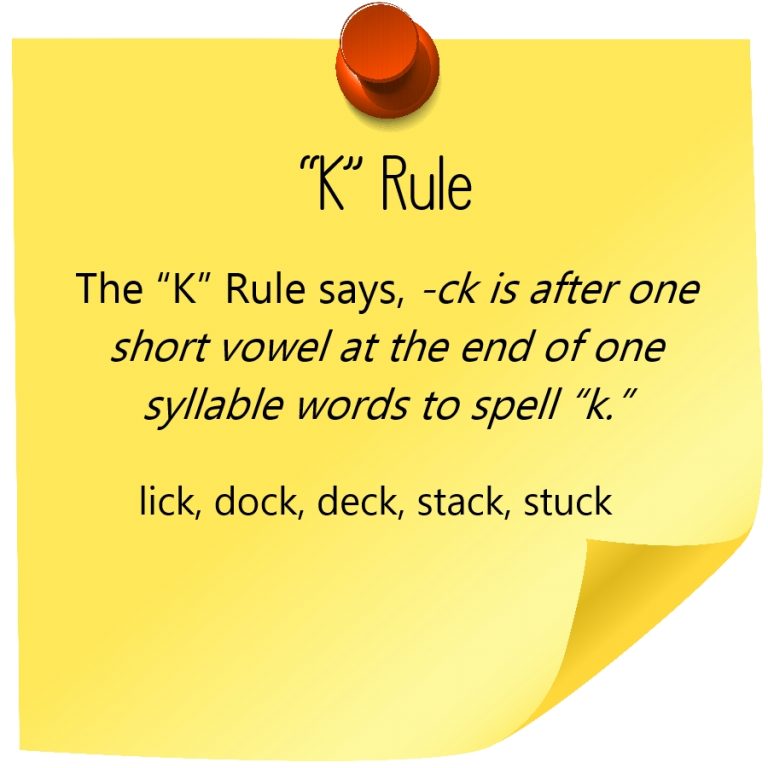
    Once students understand the K (-ck) Rule, the next step is to give them plenty of opportunities to apply it in reading and spelling. The K Rule tells us: When you hear /k/ at the end of a one-syllable word after one short vowel, use -ck. Examples: But knowing the rule and applying it are…

    Read More K (-ck) Rule Practice: Spelling, Dictation & Nonsense WordsContinue

Page navigation

Previous PagePrevious 1 2 3 4 Next PageNext
  • Home
  • Teaching Articles
  • Shop
  • Courses
  • Resources
  • Home Support
  • Start Here
Support OGforALL

© 2026 All Up Literacy Website Design by Christi Fultz

Review Cart

No products in the cart.

  • Teaching Articles
  • Start Here
  • Shop
    • Online Store
    • TPT Shop
    • Courses
    • My Account
    • Cart
  • Courses
  • Home Support
Search