
How to Teach Consonant Spelling Sounds in Orton Gillingham
Often in phonics, we talk about letters and the sounds they make. For example, the letter d says /d/ as in dog. That’s familiar and expected.
What I had never been taught before learning Orton Gillingham, however, was how to spell a sound.
This concept—spelling sounds versus reading sounds—is a powerful (and overlooked) lesson in structured literacy instruction.
How Do You Spell a Sound?
When students are reading, we often ask:
What sound does this letter make?
That’s a reading sound.
But when students are spelling or writing, we flip the question and ask:
What letters can make this sound?
That’s a spelling sound.
In other words:
- Reading sounds go from letters ? sounds
- Spelling sounds go from sounds ? letters or letter combinations
This distinction matters—especially for struggling readers and spellers.
How Do You Spell a Sound?
There are letters that make sounds, d says “d” (dog), and there are sounds made up of letters, the sound “sh” can be made using the letters sh (shout) or ch (chef).
We call that how you “spell” a sound. You have a sound, and you then say/write all of the letters or letter combinations that make that sound.
This can come in handy when teaching how to spell and read. Knowing that certain letters and letter combinations make certain sounds that may not look right at first, but this knowledge, that letters and combinations of letters make sounds, can make a word that is foreign suddenly seem logical.
Students are taught that gh can say “f” in a word like laugh or cough, but students are also taught that the sound /f/ can be made using the f, ph, lf, and the gh. This is “spelling the sound.”
Spelling Consonants (a List)
Here is a list of each consonant and how to spell the sounds :
“h” h (hip)
“j” j (jump), g (e,i,y) (gem), -ge (rage), -dge (judge), du (educate)
“l” l (liver)
“v” v (violin)
“b” b (best)
“m” m (milk), -mb (comb), -mn (column)
“sh” sh (shower), ch (chef)
“r” r (rest), wr (wrench), rh (rhino)
“p” p (pest)
“f” f (fish), ph (phone), -lf (calf), -gh (laugh)
“sk” sc (scoot), sk (skate)
“ks” x (box)
“n” n (nose), gn (gnome), kn (knife)
“th” th (thimble) unvoiced
“g” g (glue), gh (ghost), gu (guitar)
“ch” ch (church), tch (match), tu (picture)
“kw” qu (queen) (qu together are considered a consonant in OG)
“s” s (scar), c (cist – e,I,y, rule), sc (science), ps (psychic)
“gz x (exit)
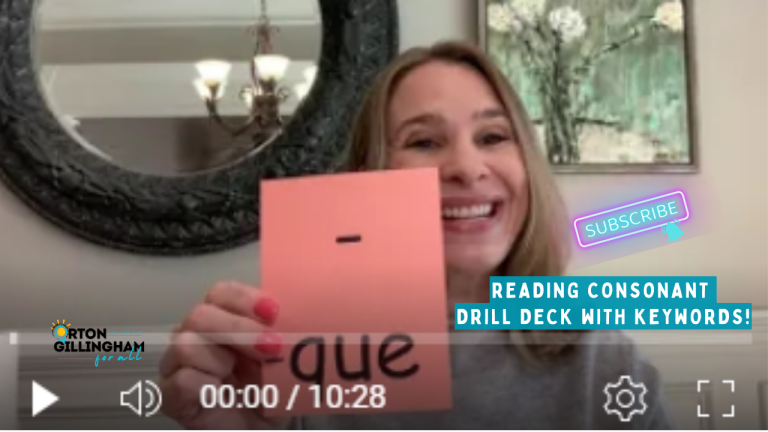
“k” c (cram), k (kick), ck (kick), ch (Christmas), lk (chalk), que (antique)
“ng” n (think, thing)
“w” w (wing)
“d” d (dog), -ed (bogged)
“t” t (tick), -ed (jumped)
“z” z (zoo), s (was)
“hw” wh (while)
“th” th (mother) voiced
“y” y (yes)
Why Orton Gillingham Teaches Spelling Sounds Explicitly
Orton Gillingham doesn’t assume students will “pick this up.”
Spelling sounds are explicitly taught, practiced, and revisited over time.
When students know:
- a sound
- all the ways it can be spelled
- and when those spellings typically appear
Spelling becomes strategic instead of guesswork.
And that’s the goal.
How to Teach Spelling Sounds: A Simple Tip
When introducing a new sound in your lesson (for example, /k/), have students not just learn the common letter (c or k) — but also brainstorm or discover the other letter combinations that can represent /k/ (e.g. ck, ch, que).
Use a sound-spelling chart and encourage students to reference it when spelling or reading. Over time, this builds flexibility and a deep understanding of the English language.
Complete, Ready-Made Lessons to Make Your Lessons Easy!


More Links:
More Links:
Workbook Store: https://bit.ly/3llnvDp
Drill Deck Book: https://bit.ly/3V0VoKY
Scope & Sequence Workbooks: https://bit.ly/4dx6pwy
Readers & Packets: https://bit.ly/3WzuP2G
SOS Technique Workbook: https://bit.ly/3GQihvP
Generalization Packets: https://bit.ly/3Wwn4Kh
Donations help us continue to bloom!
Recommended products
-

Read & Spell Foundations System Consonants & Short Vowels | Structured Literacy for Early Readers
$14.99 -

Scope and Sequence Bundle | Reading & Spelling System
$49.50 -

Short Vowel Rules Bundle | FLOSS, -ck,-tch, -dge Rules | Packets
$15.50 -

VCCV Bundle Packets + Fluency Stories | RABBIT, REPTILE, CANDY and HORNET Words
$20.66


This is what we ran through last year with my girls. I really think it helps cut down confusion as they learn to spell! However, I added the wh to the “h” sound (as in who). I also noticed as I watched a video writing program that we must not properly pronounce the beginning sound of while and what (etc)–when we say it, it sounds just like an “h” sound. When he pronounced it, it was like you point out here (hw). I also think this is a huge part of where people like my husband who are very, very logical get left out in phonics in the early grades.
You know, the “hw” is more just a little breath at the beginning and I’m not sure how much difference it makes on how a kid learns, BUT it is how I was taught in the OG class. I think as long as the child understands the spelling it is fine to group it either place. I also see why they group it in “hw” though. When you say, house, your lips are in a totally different place than the word Who. I think that is the real difference.
Thank you so much for your support of my blog!
That is SUCH a good point about the position of the mouth! You are right! A fun little point to share with my kids, too!!
And you’re welcome! There are some homeschoolers who will just eat this up! (Like me!)
Will you please explain the “gz – x(box)?
Hi Tracie, thank you so much! You actually found an error on my part. I have updated the post. It should have said x “gz” with the word Exit. X also says, “ks” as in box. So, x makes two sounds — “gz” as in exit and “ks” as in box. Some people have said they do not here the “gz” sound, but in my Southern dialect, it’s pronounced. I hope this clears up the question. I apologize for my error!
Nice blog thanks for poosting
I’m seeing online videos saying y as a consonant has the long e sound at the beginning of the /y/ sound like in yes. Can you weigh in? Thanks!
Usually, y as long e is at the end of multi-syllabic words, and we teach those as VCCV CANDY Words. Y at the beginning of a word is going to be a consonant, for sure. Yarn, yes, yield, you, yesterday are examples, but it makes a consonant sound /y/. The AY on the word DAY is a vowel team, that’s why it says a long a sound.
Y makes 3 vowel sounds: short i (as in gym), long i (as in cry), and long e (as in candy or baby). Y can also be a suffix in a word like dusty (dust+ the suffix y) and it too will make the long e sound.
Hope this helps! Please let me know if you have follow-up questions. This is a video on CANDY Words: https://youtu.be/SnDXXQCFqzQ