
Teaching Consonant-LE: Lesson Sequence(VIDEO)
If you’ve already read my article explaining what Consonant-LE is, this video picks up with the next question:
How do you actually teach it?
Below is the lesson sequence I use with students. It starts with recognizing the pattern, then moves into reading, spelling, syllable division, and connected text.
From Orton Gillingham Coaching
Watch on YouTube: How to Teach Consonant LE Syllable Pattern from Orton Gillingham Coaching
Before You Begin
By the time I introduce Consonant-LE, students already know Closed, Open, Magic E, and R-Controlled syllables. They have also begun dividing VCCV and VCV words, so they understand that words can be broken into syllables.
Now we’re ready to add the fifth syllable type in the REVLOC sequence: Consonant-LE.
Step 1: Introduce the Pattern
I don’t begin with full words.
Instead, I introduce the syllable pattern itself.
Students learn that:
- Consonant-LE always comes at the end of a word.
- The e is silent.
- This syllable doesn’t have its own vowel sound.
- In REVLOC, it is coded with L.
I have students read and spell syllables such as:
-ble • -dle • -fle • -gle • -kle • -ple • -tle • -zle
I usually save -cle (circle) until later because those words tend to be a little more advanced.
Step 2: Mix It with Other Syllable Types
Once students recognize Consonant-LE by itself, I mix it with Open, Closed, Magic E, and R-Controlled syllables.
Games and sorting activities work well here because students begin noticing the pattern instead of guessing.
Step 3: Start with Puzzle Words
I always teach Puzzle Words first because the first syllable is a predictable Closed syllable.
Students:
- underline the vowel
- underline the Consonant-LE ending
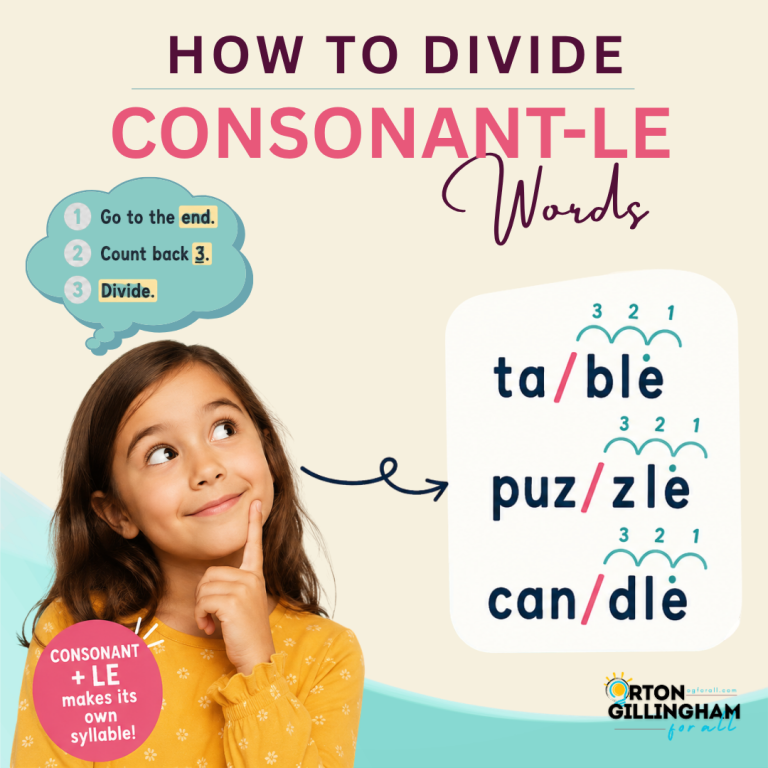
- go to the end and count back three
- divide the word
- code the syllables
- read each syllable before reading the whole word
This routine quickly becomes automatic.
Once Puzzle Words are comfortable, I introduce Table Words, which follow the same Count Back 3 strategy but begin with an Open syllable.
Step 4: Make Sure They’re Applying the Pattern
Once students are reading real words successfully, I like to add nonsense words.
If they can divide and read a nonsense word correctly, I know they’re using the strategy, not memorizing familiar words.
Another activity is having students choose the correctly spelled word.
For example:
- gaggle or gagle
- bibble or bible
- fizzle or fizle
- mapple or maple
These quick comparisons build spelling awareness while reinforcing the pattern.
Step 5: Read, Spell, and Write
Finally, students need lots of opportunities to apply what they’ve learned.
Practice should include:
- reading word lists
- reading sentences
- decodable stories
- dictation
- syllable division review
The more students see Consonant-LE in connected text, the more automatic the pattern becomes.
Final Word
Consonant-LE often seems unusual at first because it’s the only syllable type without its own vowel sound.
Once students learn to go to the end, count back three, and divide, however, it usually becomes one of the easiest syllable patterns for them to recognize.
Like every Orton-Gillingham concept, start with simple, predictable words first. Build confidence before introducing more advanced patterns like circle, turtle, or angle.
You may also enjoy:
Ready to Teach Consonant LE Syllable Division?
If you’d like ready-made lessons that walk students through Consonant+LE syllable types and syllable division step-by-step, you’ll find full lessons inside Scope and Sequence Workbook 2.
Everything is laid out in order — from coding to division to reading practice — so you’re not piecing it together yourself.
If you’re new to Orton-Gillingham and need a clear, easy-to-follow path to learning syllable types and division patterns, my structured literacy courses walk you through the “why” and the “how” behind it all.
Products from the video:
Sandpaper Letters, Lowercase only: https://amzn.to/3APKAnq
Sandpaper Letters, Uppercase & Lowercase: https://amzn.to/3BXZ5XN
If you prefer sand trays & sand:
Sand Trays: https://amzn.to/3aQgRQy
Sand (25 lbs., sand color): https://amzn.to/3AVi0kD
FTC: Some links included in this description might be affiliate links. If you purchase a product through one of them, I will receive a commission (at no additional cost to you). I truly appreciate your support of my channel. Thank you for watching! Video is not sponsored.
Recommended products
-

Read & Spell Foundations System Consonants & Short Vowels | Structured Literacy for Early Readers
$14.99 -

Scope and Sequence Bundle | Reading & Spelling System
$49.50 -

Short Vowel Rules Bundle | FLOSS, -ck,-tch, -dge Rules | Packets
$15.50 -

VCCV Bundle Packets + Fluency Stories | RABBIT, REPTILE, CANDY and HORNET Words
$20.66



I teach the syllable type too. “Consonant plus le, go to the end and count back three.” I create a visual of a candle.
Can.dle.
That’s a great idea! Thank you.