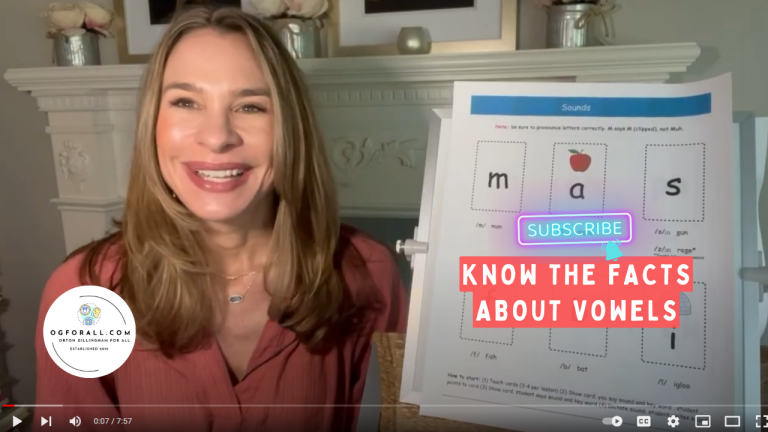
One of the Most Important Parts of Lessons is Drill Cards. Make Them, Use Them, What’s Best?
Many tutors and teachers ask, Where do I start lessons with my students? The answer is Drill Cards. The answer: almost all Orton Gillingham lessons start with drill cards. They are perfect for the multi-sensory, three-pronged approach of auditory, visual, and kinesthetic learning.
Drill cards are used to teach the letter names, letter sounds, and keywords. They are used to teach letter combinations with keywords, syllable types, R-controlled vowels, and much more.
These cards should be used in each lesson to teach speed and automaticity of letters and concepts.
There is a lot you can do with drill cards in lessons.


Using Drill Cards in a Lesson
Always start a lesson by drilling what a student has already learned, then introduce new concepts. When a concept is new, you show the card and the student says the sound and the keyword (if there is a keyword) with the sound.
They should also write or trace the letter(s) in something like sand or on a sheet of paper (rough surfaces work best for a tactile experience). Sandpaper letters are another option for this. It’s not always convenient to get out the sand or shaving cream, so these are a good alternative.
How do you know if a student has conquered the sound or concept – they can say it as fast as you can flip the card.
Sandpaper Letters, Lowercase only: https://amzn.to/3APKAnq
Sandpaper Letters, Uppercase & Lowercase: https://amzn.to/3BXZ5XN


Activities with Drill Cards
Card Drills
Basic Drills. Show the card, and students say the letter, the sound, and the keyword. We are looking for them to be automatic with recognition.
Eventually, you can drop the keyword and letter name and have the student say the sound.
Timed Drills. Use a timer to see how many cards the student can correctly identify within a set period. This adds a fun, competitive element.
Error Correction. If a student gets a card wrong, provide corrective feedback and have them repeat the correct response.
You can put those trouble cards in a pile to the side and be sure those are the cards for the next lesson. Also recommended is keeping a checklist in a student’s paperwork where they can see their progression of learning. It’s exciting for them to see how far they have come.
Blending and Segmenting
Sound Blending. Place cards with individual phonemes and have students blend them to form a word. For example, put the C-A-T cards together and have the student blend each sound to read the word.
You can place a short vowel card down on the table, then place known consonant cards on either side of the vowel, and have the student read different words with the vowel sound.
Keep putting different consonant cards on top of one another and sound out each letter individually, then read the word. It’s okay if it is a nonsense word.
Kinesthetic Techniques
Air Writing. Show a drill card, and students write the letter or word in the air while saying the sound.
Tactile Writing. Students use a rough or textured surface, like a sand tray or shaving cream, or sandpaper letters, to write the letter while vocalizing the sound. They can also say the keyword.

Spelling Practice
Dictation. Say a sound and students find the corresponding card, and then write the letter or letters and the keyword on paper.

Review and Reinforcement
Daily Warm-Up. Use drill cards as a warm-up activity to review previous lessons.
End-of-Lesson Review. End each session with a quick drill card review to reinforce the day’s learning.
Decks
- Reading Consonants
- Reading Vowels
- Reading Vowels with R
- Diacritical Markings
- REVLOC
- Roots
- Short Vowel Strips
- Suffixes
- Syllable Division
- Language Vocabulary
- Prefixes
- Sight Words
- Blends
- C&G Rule
- Spelling Consonants
- Spelling Vowels
- Spelling Vowels with R
If you have decks that differ from these, it’s fine. These are basic decks and there are probably more.
To Buy or Create?
Should you buy these cards or create your own?
You can purchase drill cards, but with a little time invested, they can be made at home.
To make it easier (less time-consuming) they can be printed on the front and written on the back with a pen, but it is nice to have them printed front and back.
On my website is a free template to make creating cards at home easier.
OGforALL.com also has a Drill Deck Book with pages to fold-over and create cards and sticker templates to print stickers and attach them to index cards.

Where Should Drill Cards Live?
The “Jewel Box” is an important tool. “Jewel Box” (or Jewel Case) got its name from children, and the name stuck (according to the Orton Gillingham Manual). The Jewel Box is a box that holds card decks for lesson drills.
Find this drill card box here.


We’ve done the work for you!
The Fast Track Bundle is perfect to get started. It contains Scope and Sequence Workbooks 1 & 2 + Drill Cards. Check it out here.
Recommended products
-

Read & Spell Foundations System Consonants & Short Vowels | Structured Literacy for Early Readers
$14.99 -

Scope and Sequence Bundle | Reading & Spelling System
$49.50 -

Short Vowel Rules Bundle | FLOSS, -ck,-tch, -dge Rules | Packets
$15.50 -

VCCV Bundle Packets + Fluency Stories | RABBIT, REPTILE, CANDY and HORNET Words
$20.66