A Simple System for Planning Orton-Gillingham Lessons
When people start planning lessons, one of the biggest questions is usually:
“What exactly am I supposed to put into the lesson?”
Not just concepts, but the actual flow of the lesson.
What should always be included?
What parts can rotate in and out?
How long should each section take?
What happens if the student struggles and the whole plan goes sideways? (Because honestly… sometimes that happens.)
You may plan to introduce a new concept and then realize five minutes into review that the student still is not hearing the difference between short e and short i consistently. At that point, the lesson changes.
That’s normal.
A lesson plan is not supposed to lock you into a script. It is there to help organize the lesson so you are not just pulling activities out of thin air while trying to remember what to review next.
Start With the Parts That Ground the Lesson
There are a few things I almost always include in a lesson because they help tie reading and spelling together. For me, those are:
- review concepts
- learned words
- dictation
- oral reading
Those parts alone can create a solid lesson.
Then other sections may be included depending on the student, the pacing, and where you are on your scope and sequence, and the concept being taught:
- phonological awareness
- syllable work
- grammar
- writing
- introducing a new concept
Not every lesson has to include every single one.
That is where people sometimes overwhelm themselves. They think if they leave something out, they are “doing OG wrong.”
Some lessons are heavier on review. Some are heavier on new material. Some lessons feel smooth, and some feel like putting out fires the entire time.
No-Prep Lesson Planning
When lesson planning starts taking more time than the actual lesson, the Start Here Teaching System can help give some of that time back. It includes lesson planning templates, sample lessons, drill cards, no-prep activities, scope and sequence guidance, and structured literacy resources designed to help reading and spelling lessons flow together more easily.
Review Tells You a Lot
Review is usually where I can tell how the lesson is actually going to go.
A student may have looked solid on a concept the lesson before, but during review, you suddenly realize they still are not automatic with it. Or maybe they can read the concept, but spelling it falls apart. That changes the direction of the lesson.
Sometimes I spend far more time reviewing than originally planned because the student needs it. Other times review moves quickly and we are ready to build on it.
That flexibility is part of the process.
Dictation Is Doing More Than People Think
Dictation is one of those parts of a lesson that can cover a lot of ground at once. You are working on:
- spelling
- listening
- sound processing
- handwriting
- grammar
- sentence structure
- reading back for errors
And it does not always have to be full sentences.
Sometimes dictation is:
- sounds
- syllables
- words
- phrases
- nonsense words
- vowel patterns
One thing I always do is have students read back what they wrote. That is where a lot of self-correction happens. Students will often read what they thought they wrote unless they slow down and really look at it.
Lessons Should Flow Together
One thing that helps lessons feel less scattered is when the parts connect naturally.
For example: if we are reviewing the FLOSS Rule, that may carry into dictation words, oral reading, and even grammar sentences.
Or if we are working on syllable types, that may connect to reading longer words during oral reading.
The lesson starts feeling connected instead of feeling like: “Now we stop this and switch to a completely unrelated activity.”
Timing Matters… But Not That Much
People often ask how long each section should take. Honestly, it depends.
A one-on-one lesson may move very differently from a small group lesson. Younger students usually need more movement and shorter activities. Some students need repetition far longer than others.
Most lessons usually fall somewhere around 30–60 minutes, but I personally don’t think lessons work well when every section is timed too rigidly.
Sometimes a student needs to stay with something longer. Sometimes you skip a section completely. Sometimes the “new concept” you planned becomes tomorrow’s (or next week’s) lesson instead.
All normal.
Prefer to Watch Instead?
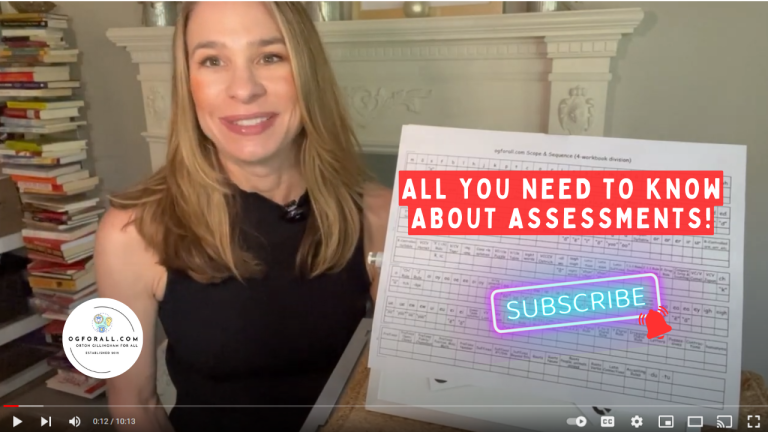
I also created a companion video where I walk through lesson planning ideas and how these lesson parts work together inside an OG lesson.
Small Groups Require More Flexibility
Group lessons are their own thing.
Usually students are not all in exactly the same place, even if they are working on the same general concepts.
What I usually try to keep consistent is the structure of the lesson itself, while adjusting the difficulty within the activities.
One student may read words while another reads phrases.
One student may need support during dictation while another works independently.
One student may move into syllable division while another still needs more blending practice.
You adjust without completely changing the lesson flow.
Not All Lessons Are Fancy Lessons
I think sometimes social media makes it feel like every lesson needs:
- ten activities
- color-coded centers
- games
- crafts
- elaborate setups
But some of the best lessons are simple. Clear review and instruction. Practice. Reading. Spelling. Repeating concepts over time.
That is where a lot of growth happens.
Want a Ready-to-Use Lesson Planning System?
The Lesson Planning Blueprint was designed to help organize lessons without overcomplicating them.
It includes:
- lesson planning templates
- fillable PDFs
- sample lessons
- pacing guidance
- small group ideas
- planning structure for reading and spelling lessons
It is meant to work alongside your scope and sequence and help you organize the actual flow of instruction.
No-Prep Lesson Planning
When lesson planning starts taking more time than the actual lesson, the Start Here Teaching System can help give some of that time back. It includes lesson planning templates, sample lessons, drill cards, no-prep activities, scope and sequence guidance, and structured literacy resources designed to help reading and spelling lessons flow together more easily.
Recommended products
-

Read & Spell Foundations System Consonants & Short Vowels | Structured Literacy for Early Readers
$14.99 -

Scope and Sequence Bundle | Reading & Spelling System
$49.50 -

Short Vowel Rules Bundle | FLOSS, -ck,-tch, -dge Rules | Packets
$15.50 -

VCCV Bundle Packets + Fluency Stories | RABBIT, REPTILE, CANDY and HORNET Words
$20.66