Vowel Teams Explained
Ever wondered why rain, boat, and light don’t follow the same vowel rules? That’s the magic (and challenge) of vowel teams — two or more letters working together to make one sound. Teaching them doesn’t have to be tricky.
First, we introduce each team, their sounds, and the keywords that help students remember them. Then we explore vowel team syllables and, finally, the division rules that tie it all together.
What is a Vowel Team?
Vowel teams are vowel sounds formed by vowels when two or more letters work together to make a single sound.
For example, -igh, -eigh, -aw, -ow, -ew are all vowel teams, even though they contain a consonant to make their sounds.
Other vowel teams are, ai, ay, oa, oe, ee, oi, oy, oo, ow, ie, ou, au, aw, ea, ey, ue, ew, ui, eu, ei.
Some vowel teams can make more than one sound. For example, ea can make the long e, short e, and long a sound. The eagle ate bread and steak is a “remember sentence” we use to illustrate the sounds of ea.
There are also vowel teams paired together to create vowel team generalizations. Generalizations cover the vowel teams: oi/oy, ou/ow, au/aw.
Want Ready-to-Use Practice?
The Vowel Team Read & Spell Workbook includes printable worksheets, dictation pages, fluency stories, and spelling activities for teaching vowel teams. A helpful companion for reinforcing these vowel team spelling patterns through reading and writing practice.
Something to remember: is QU a vowel team as in the word, Quit? It is not.
QU is considered a consonant and always appears together in English. Why is this important? For pronunciation. This makes the “i” in Quit stay short as it would in most closed syllables.
Vocabulary
Vowel teams are made up of Diphthongs and Vowel Digraphs.
Diphthongs are two letters making two separate sounds, but when blended together make a new sound. Examples oi saying “oi” as in oil or ou saying “ou” as in out.
Digraphs are two letters that come together making one new sound. Examples of vowel digraphs are ai saying long a, or oe saying long o.
Examples of Vowel Teams
A few examples of vowel teams include:
- ai as in rain
- ea as in beach
- ee as in see
- oa as in boat
- oi as in coin
Vowel Teams can also be:
- aw as in saw
- ew as in grew or few
- eigh as in eight
- igh as in light
Here is an article with a complete list of vowel teams.
How do we teach vowel teams?
Drill cards are a great place to start. Students of Orton Gillingham are used to drill cards. You use your scope and sequence to know what order to teach the teams.


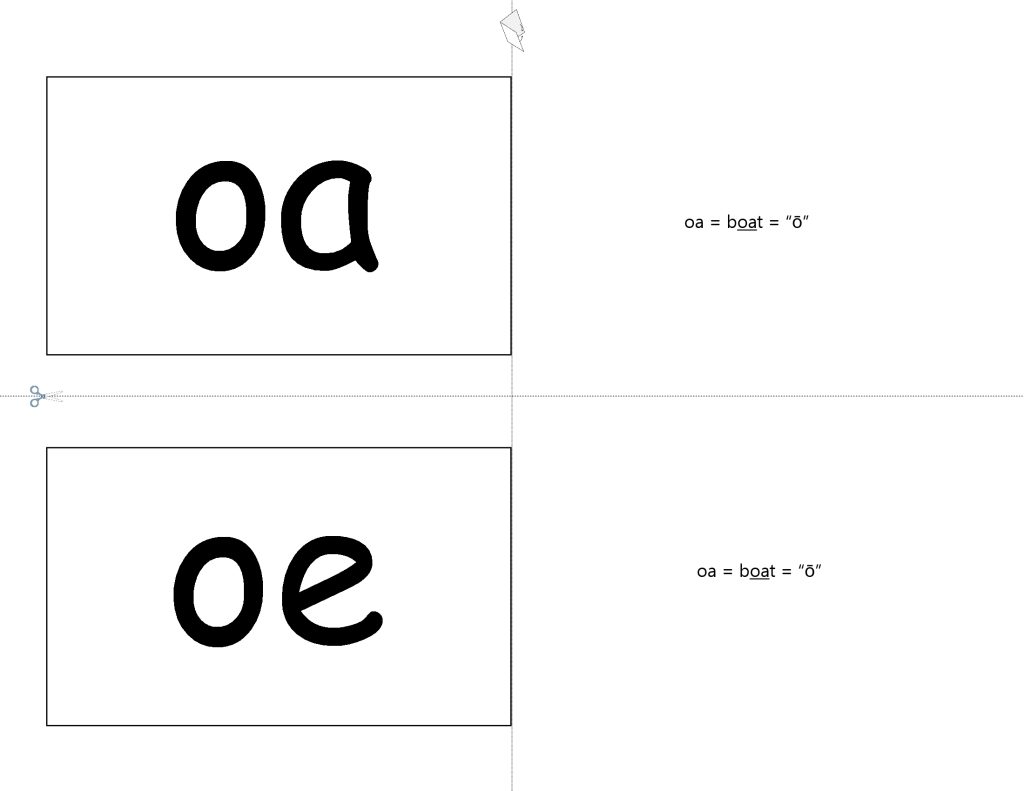
It’s the same as when teaching consonants or vowels with drill cards. Vowel Teams have cards with a sound or sounds and a keyword.
Use multi-sensory learning by tracing, writing, and saying the letters and keywords out loud. You can use sand, or tracing while saying the sounds, or air writing – all the same techniques used in other sound/letter teaching.
Incorporate auditory, visual, and kinesthetic components into your lessons and work to get students automatic. The goal is to have them say the sound as fast as you can show the cards.
Reading. Have students read words in groups to get used to the patterns of the teams. Move from words to phrases, and from phrases to sentences, and from sentences to stories.
In stories, have students highlight words with vowel teams in them.
Dictation. Dictate words, phrases, and sentences with vowel team words in them.
Give students words and have them write sentences using those words. See if they can write a short story with five to 10 words. Be sure they read what they write.


A Final Word
Teaching vowel teams is like teaching other vowels. Drill cards, spelling, writing, reading, and dictation are the best ways to get these teams into a student’s memory before moving into teaching vowel team syllables (the V in REVLOC).
Looking for More Structured Literacy Support? No Prep Help
Vowel teams are just one part of helping students understand the patterns of reading and spelling. With consistent reading, dictation, word study, and structured practice, these spelling patterns begin to feel much more manageable for students.
If this style of teaching feels helpful, you may also like:
The Fast Track Course for a broader introduction to teaching reading and spelling through structured literacy and Orton-Gillingham concepts
The Vowel Team Read & Spell Lessons for printable practice and fluency activities
Recommended products
-

Read & Spell Foundations System Consonants & Short Vowels | Structured Literacy for Early Readers
$14.99 -

Scope and Sequence Bundle | Reading & Spelling System
$49.50 -

Short Vowel Rules Bundle | FLOSS, -ck,-tch, -dge Rules | Packets
$15.50 -

VCCV Bundle Packets + Fluency Stories | RABBIT, REPTILE, CANDY and HORNET Words
$20.66