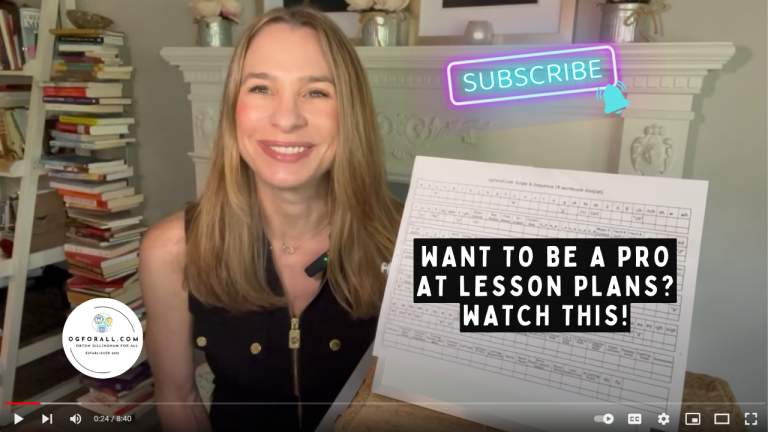
Super Helpful Tips and Tricks for Teaching Students Accenting
Teachings vary on when beginning accenting is taught. If a student is advanced enough, accenting can start with RABBIT Words, because that’s when we begin teaching multisyllabic words in Orton-Gillingham. Certainly, by the time we arrive at VCV Words on the Scope and Sequence, accenting should be introduced.
When students understand where the stress falls in a word it can improve mispronunciations, reading struggles, and even spelling errors.
The good news? There are easy, practical strategies we can use to help students recognize accent patterns and apply them to words. Let’s explore engaging ways to practice accenting.

Accenting Tip #1
Have the student pronounce the word one way and then another. Which sounds right?
- Is it ti ger’ or ti’ger? (ti’ger)
- Is it pun’ ish or pun ish’? (pun’ ish)
- Is it in’ clude or in clude’? (in clude’)
- Is it to’ day or to day’? (to day’)
Accenting Tip #2
A helpful rule when accenting is that the accent will never fall on a schwa syllable. If there is a schwa in a syllable, never accent that syllable.
Examples
- Bison (VCV Word): bi’ son (the o in the son sounds like a short u, not accented)
- Balloon (VCCV Word): bal loon’ (the a sounds like a short u, not accented)
- Lintel (VCCV Word): lin’ tel (the final e sounds like a short u, not accented)
- Mattress (VCCCV Word): mat’ tress (the final e sounds like a short u, not accented)
Accenting Tip #3
Another accenting trick is to say a word like you are calling a dog, like you are yelling it, the longer syllable is usually the accented one.
For example, if I were calling my dog I might say, tiiii ger – the ti is the accented syllable.
Try Calling the Dog With These Words
- Balloon
- Lintel
- Mattress
- Today
- Punish
- Include
Accenting Tip #4
One last trick is to have a student put their hand under their chin and feel for when their chin goes down. In the accented syllable, the chin will go down and the unaccented syllable will be softer, not going down.
Try Putting Your Hand Under Your Chin
- Say, Rabbit
- Say, Camel
- Say, Happy
A really good way to observe the action is to record it!


A Final Word on Accenting in Lessons
Accenting is an often-overlooked but essential part of teaching reading and spelling. By helping students recognize where stress falls in a word, you’re setting them up for better pronunciation, smoother reading, and more accurate spelling.
If you’re a teacher, tutor, or homeschooling parent using the Orton-Gillingham approach, hopefully, these simple tips will put a little accenting fun in your lesson plans. It’s a small step, but makes a big impact on a student’s success!
Video of this article: https://youtu.be/2gwPbYdwaQQ
Prepared Lessons, ready-to-go!
Scope & Sequence Workbooks: https://bit.ly/4dx6pwy
Drill Deck Book: https://bit.ly/3V0VoKY
Teachers Pay Teachers Shop
Recommended products
-

Read & Spell Foundations System Consonants & Short Vowels | Structured Literacy for Early Readers
$14.99 -

Scope and Sequence Bundle | Reading & Spelling System
$49.50 -

Short Vowel Rules Bundle | FLOSS, -ck,-tch, -dge Rules | Packets
$15.50 -

VCCV Bundle Packets + Fluency Stories | RABBIT, REPTILE, CANDY and HORNET Words
$20.66