
Understanding R-Controlled Syllables and Bossy R Patterns
Once students learn Bossy R vowel patterns like AR, OR, ER, IR, and UR, the next step is learning how those patterns work inside syllables and longer words.
This is usually the point where reading starts getting more challenging for students. Up until now, they’ve mostly worked with one-syllable words and simpler patterns. Now they’re dividing bigger words, labeling syllables, and trying to apply everything they’ve learned all at once.
That can feel overwhelming at first.
One thing that can confuse students is that R-controlled syllables may look like closed syllables at first.
For example, a student might look at the word fir and think, “The vowel is closed in by consonants, so it must be closed.” But the R changes the vowel sound. Even though the syllable looks closed, it is actually R-controlled.
That’s why students need practice recognizing Bossy R patterns before they start using them inside longer words. Once they can spot ar, or, er, ir, and ur quickly, they are much better prepared to divide and read words with R-controlled syllables.
Before Teaching R-Controlled Syllables
Before I expect students to divide R-controlled syllables, I spend time teaching the vowel patterns themselves using a multisensory approach. We use:
- phonogram cards
- drill routines
- dictation
- tracing
- blending activities
- and reading passages
The goal is familiarity first.
I usually teach AR and OR before the others because they are the most consistent in both reading and spelling. Students can hear those sounds more clearly, and they tend to stick faster.
Then come the trickier patterns:
- ER
- IR
- UR
Those are harder because they all commonly say /ur/, and there really isn’t a simple spelling rule students can rely on.
This is where repetition becomes important. Students need to:
- see the words
- hear the sounds
- spell the patterns
- and read them repeatedly in connected text
Over time, the patterns start becoming automatic.
Teaching Bossy R in Lessons
If you’re looking for a structured path for teaching reading and spelling patterns like Bossy R, the Start Here Teaching System includes scope and sequence guidance, drill routines, lesson planning tools, and structured literacy resources designed to work together.
Moving Into Syllable Work
Once students are comfortable with the vowel patterns, we begin working with syllables directly.
At first, I keep it simple. Students read syllables like:
- mur
- her
- corn
- tar
Then we start mixing syllable types together:
- closed syllables
- Magic-E syllables
- open syllables
- and R-controlled syllables
One activity students usually enjoy is building words from syllable cards.
For example:
- DIN
- NER
Students read each syllable slowly:
DIN… NER…
Then blend the word together: DINNER.
That moment where they realize they just read a bigger word on their own is huge for many students.
Why This Helps With Longer Words
By the time students reach R-controlled syllables, they have usually already worked through:
Now they’re ready for VCCV Hornet words, where one syllable is closed, and the other is R-controlled.
Because students already know the vowel patterns, dividing the larger words feels much more manageable. Instead of seeing one giant word, they begin seeing familiar chunks.
That’s really the goal of syllable division instruction in the first place.
WAYS TO PRACTICE R-Controlled SYLLABLES
Activity #1
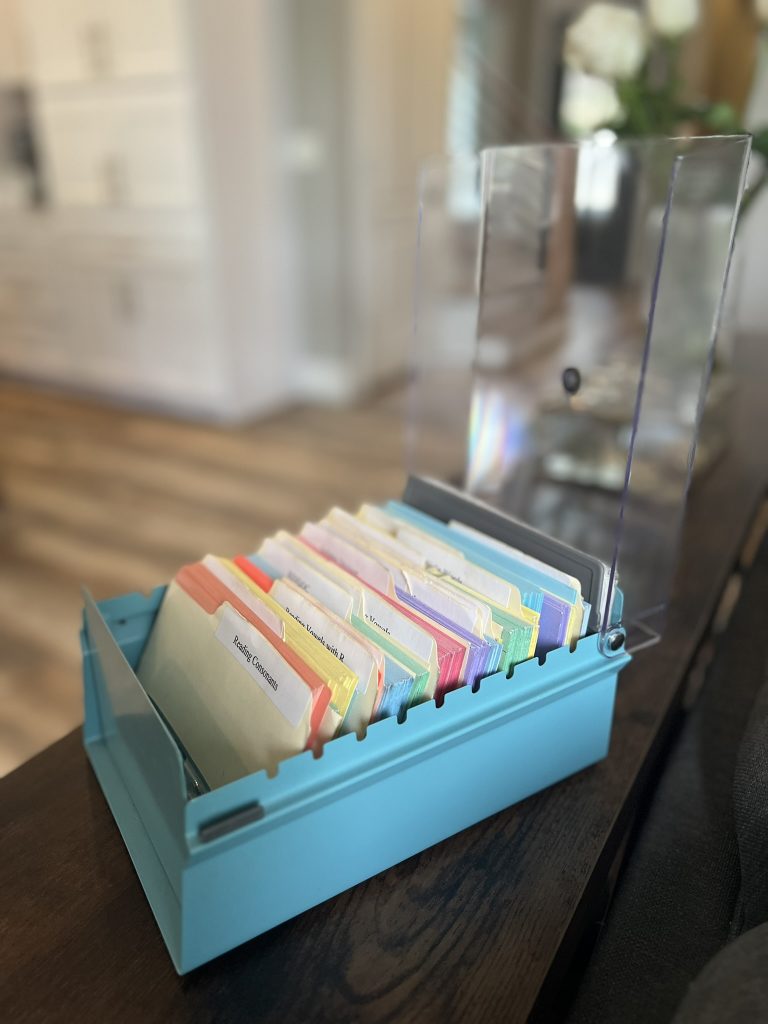
First, you have cards in your reading vowels deck that teach each sound with a keyword.
Do this before you ever mention the R-Controlled syllable. Get the student used to seeing the pattern, and knowing the sound, and keywords.
Start small, with OR and AR because those are the most phonetic in reading and spelling. ER, IR, and UR all sound alike. Those are trickier when it comes to spelling.
The deck then expands into more complex R-Controlled vowels, for example, EAR, URE, ERE, IRR, and more.


Activity #2
Have cards with syllables on them and have students go through and read the syllables out loud. Once you get them used to seeing R-Controlled syllables, mix in closed, magic E, and open syllables.
You can also use these cards for sorting into syllable types, but make sure they read out loud too.

Activity #3
Have your students label syllables with an R (the R in REVLOC). You can start with Closed and R-Controlled, then move to Closed with Magic E, Open and R-Controlled.

Activity #4
Have students put two syllables beside each other and read them slow then read faster. They will be reading words and be impressed with themselves!
For example, have cards with the syllable DIN (closed) and NER (R-controlled), student reads, DIN (slow) NER (slow), and then DIN-NER (faster, then fast). They read DINNER!
This is a great start to dividing VCCV HORNET words.
Where REVLOC Fits In
Some Orton-Gillingham teachers use the REVLOC strategy to help students remember the order for identifying syllable types.
In REVLOC, the “R” reminds students to look for R-controlled syllables first because those patterns tend to take over the vowel sound.
The reminder sentence says:
“Always look for R first, then look for E, V, L next, and last look for O and C.”
REVLOC is a way to slow students down and help them look at patterns instead of guessing.

Final Word
A student has now been working with syllables and syllable types, so they should have a grasp of what a syllable is by now. They will have been dividing words as well. The hardest part of R-controlled vowels and syllables is the spelling because so many sound alike.
This is where grouping words and being patient with the learning process comes in. It takes time to learn how these words are spelled. It’s easier to teach reading these words, spelling comes slower.
Want to See How These Lessons Fit Together?
Bossy R syllables are just one part of a structured literacy sequence.
Inside the Fast Track Course, I walk through:
- lesson structure
- drill routines
- syllable types
- spelling patterns
- dictation
- decoding practice
- and how all of these pieces work together in an Orton-Gillingham lesson.
The course is designed for tutors, teachers, homeschool parents, and interventionists who want a clearer understanding of how to teach reading and spelling systematically.
Learn more about the Fast Track Course
Resources Mentioned in This Lesson
Many of the drills, dictation routines, and reading activities used for teaching Bossy R words can be found in:
Orton-Gillingham Drill Cards (PDF)
Scope & Sequence Workbook 2
Teachers Pay Teacher Shop: https://bit.ly/4acxF1e
Tools Mentioned in This Lesson
Some teachers also like using sandpaper letters for tactile sound work:
Sandpaper Letters, Lowercase only: https://amzn.to/3APKAnq
Sandpaper Letters, Uppercase & Lowercase: https://amzn.to/3BXZ5XN
Recommended products
-

Read & Spell Foundations System Consonants & Short Vowels | Structured Literacy for Early Readers
$14.99 -

Scope and Sequence Bundle | Reading & Spelling System
$49.50 -

Short Vowel Rules Bundle | FLOSS, -ck,-tch, -dge Rules | Packets
$15.50 -

VCCV Bundle Packets + Fluency Stories | RABBIT, REPTILE, CANDY and HORNET Words
$20.66


I just purchased the bundle and was in the middle of downloading the electronic copy when my computer shut down. I cannot find the link to download the electronic copy on my receipt. Can you please send me the link for both of the electronic workbooks that came with my purchase? Thank you.
Your Transaction ID:
7AC587384R0172906
Merchant Transaction ID:
89G43473W73143124
Purchase Date:
May 14, 2024
Payment to:
Enter Sage Media LLC
email.ogforall@gmail.com Payment from:
Melony Haerr
Quantity 1
Item Bundle: Scope & Sequence and Workbooks One & Two
ID Number
Price $58.50 USD
Subtotal $58.50 USD
Total $58.50 USD
Hi! I just emailed you the links. You should also receive links in your email, but sometimes those go to junk folders.
Warmly,
Jennifer