Skip to content
All Up Literacy
  • Teaching Articles
  • Start Here
  • ShopExpand
    • Online Store
    • TPT Shop
    • Courses
    • My Account
    • Cart
  • Courses
  • Home Support
All Up Literacy

What do you want to learn more about?

Consonants & Vowels SYLLABLE TYPES Syllable Division Spelling Rules & Patterns Sight Words READING Teaching Tools & Strategies Videos

  • How to Teach VCCV Candy Words (Closed + Y = Long E Pattern)
    Syllable Division

    How to Teach VCCV Candy Words (Closed + Y = Long E Pattern)

    Orton Gillingham is a phonics, rule-based approach to teaching and learning the English language. Using a scope and sequence makes it a cumulative, thorough approach to teaching English to both kids and adults. Orton Gillingham training teaches how to use multi-sensory learning to teach all of this and more!

    Read More How to Teach VCCV Candy Words (Closed + Y = Long E Pattern)Continue

  • Easy Steps to learning Syllable Division Types and Patterns, an Overview
    Featured Video | Spelling Rules & Patterns | Syllable Division | Types of Syllables | Videos

    Easy Steps to learning Syllable Division Types and Patterns, an Overview

    Today, you’ll gain a birds-eye view into why we are learning REVLOC and how to utilize syllable labeling. What is syllable division? Syllable division is a way to break down words into more digestible pieces for easier reading and spelling. Syllable Types Review – REVLOC There are six syllable types in REVLOC, and the word…

    Read More Easy Steps to learning Syllable Division Types and Patterns, an OverviewContinue

  • The 3 Sounds of -ED (How to Teach Them + Video + Activities)
    Featured Video | Prefixes/Suffixes | Spelling Rules & Patterns | Videos

    The 3 Sounds of -ED (How to Teach Them + Video + Activities)

    Most students learn that -ed is a past tense ending… but then quickly get confused. Why does jumped sound different from loved?And why does painted suddenly have two syllables? The answer is simple—but it has to be taught clearly. The suffix -ed actually has three different sounds: /t/, /d/, and /ed/ (or /?d/). Once students…

    Read More The 3 Sounds of -ED (How to Teach Them + Video + Activities)Continue

  • Let’s Talk About the “Hearing-It” in Multi-Sensory. Using Phonemic Awareness in Lessons. (VIDEO)
    Consonants & Vowels | Teaching Tools & Strategies | Videos

    Let’s Talk About the “Hearing-It” in Multi-Sensory. Using Phonemic Awareness in Lessons. (VIDEO)

    We talk about Orton Gillingham being multi-sensory. Multi-sensory means we want students of OG to hear the language (auditory), see the language (visual) and use the language as kinesthetic (feel/write). When we combine these three prongs we get a multi-sensory approach, meaning all of these senses are being used by a student to learn.  The…

    Read More Let’s Talk About the “Hearing-It” in Multi-Sensory. Using Phonemic Awareness in Lessons. (VIDEO)Continue

  • Where to Start with the Orton-Gillingham Approach
    Parent Support | Teaching Tools & Strategies

    Where to Start with the Orton-Gillingham Approach

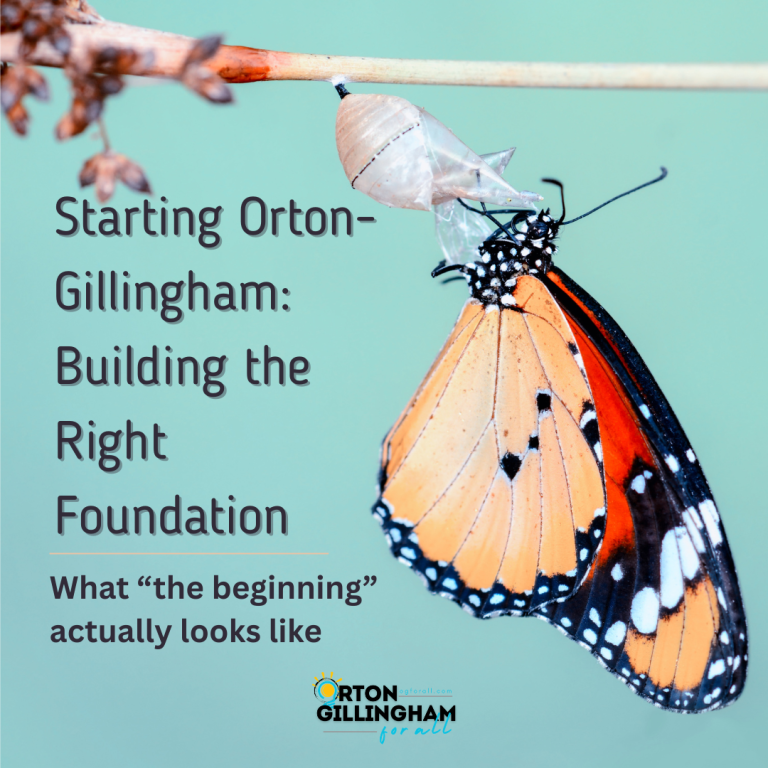
    Where do we start? One question I think many tutors and teachers have when beginning Orton Gillingham as a teaching approach with students is, Where do I start? It’s a very reasonable question! My answer would be, start at the beginning. The reason for starting at the beginning is that Orton Gillingham is a sequential…

    Read More Where to Start with the Orton-Gillingham ApproachContinue

  • Sound Spelling Versus Sound Reading in Structured Literacy
    Consonants & Vowels | Spelling Rules & Patterns | Vowel Teams

    Sound Spelling Versus Sound Reading in Structured Literacy

    Sound Spelling Versus Sound Reading, What’s the Difference? When taking an Orton Gillingham class, as a student or as a teacher, you will have two terms: Reading Consonant & Vowels and Spelling Consonants & Vowels. What’s the difference in the two? It can get a little confusing. Reading Consonant & Vowel Sounds When going through…

    Read More Sound Spelling Versus Sound Reading in Structured LiteracyContinue

  • Scope and Sequence Is the Ship, You Are the Captain
    Teaching Tools & Strategies

    Scope and Sequence Is the Ship, You Are the Captain

    A scope and sequence is a plan – the teaching of a subject (the scope) in a specific sequence.  Many subjects have scope and sequence plans. Orton Gillingham is no different – it is an extensive subject that needs to be broken down into bites for easy digestion if someone is going to teach it…

    Read More Scope and Sequence Is the Ship, You Are the CaptainContinue

  • Possessive Rules

    You’re in Possession of Orton Gillingham Possessive Rules

    Possessive rules can be easy, but can also get a little tricky when we move beyond just adding ‘s. Possessive Rules are all about ownership and can be narrowed down to a couple of categories: singular and plural. Singular Possessive Rule Singular Possessive Rule is to show ownership for a singular owner, add ‘s to…

    Read More You’re in Possession of Orton Gillingham Possessive RulesContinue

  • Home
  • Teaching Articles
  • Shop
  • Courses
  • Resources
  • Home Support
  • Start Here
Support OGforALL

© 2026 All Up Literacy Website Design by Christi Fultz

Review Cart

No products in the cart.

  • Teaching Articles
  • Start Here
  • Shop
    • Online Store
    • TPT Shop
    • Courses
    • My Account
    • Cart
  • Courses
  • Home Support
Search