Skip to content
All Up Literacy
  • Teaching Articles
  • Start Here
  • ShopExpand
    • Online Store
    • TPT Shop
    • Courses
    • My Account
    • Cart
  • Courses
  • Home Support
All Up Literacy

What do you want to learn more about?

Consonants & Vowels SYLLABLE TYPES Syllable Division Spelling Rules & Patterns Sight Words READING Teaching Tools & Strategies Videos

  • Orton-Gillingham for Every Setting: Home, Pods, Classrooms, and Tutoring
    Featured | Teaching Tools & Strategies

    Orton-Gillingham for Every Setting: Home, Pods, Classrooms, and Tutoring

    If you’ve been curious about how to bring Orton-Gillingham (OG) and the Three-Part Drill into any setting, you’re in the right place. OG works beautifully in classrooms, kitchen table learning, micro-schools, tutoring pods, and even virtual sessions.

    Read More Orton-Gillingham for Every Setting: Home, Pods, Classrooms, and TutoringContinue

  • What Is a Three-Part Drill?
    Consonants & Vowels | Featured | Reading | Teaching Tools & Strategies

    What Is a Three-Part Drill?

    What is the 3 Part Drill in Structured Literacy? A Simple Explanation and scripts for teaching students.
    The Three-Part Drill is a key component of Orton-Gillingham lessons. It’s a multi-sensory practice that helps students become automatic with the sounds, symbols, and spellings of the English language.

    Read More What Is a Three-Part Drill?Continue

  • Super Helpful Tips and Tricks for Teaching Students Accenting
    Syllable Division | Teaching Tools & Strategies | Word Stress & Accenting Rules

    Super Helpful Tips and Tricks for Teaching Students Accenting

    Teachings vary on when beginning accenting is taught. If a student is advanced enough, accenting can start with RABBIT Words, because that’s when we begin teaching multisyllabic words in Orton-Gillingham. Certainly, by the time we arrive at VCV Words on the Scope and Sequence, accenting should be introduced. When students understand where the stress falls…

    Read More Super Helpful Tips and Tricks for Teaching Students AccentingContinue

  • Rabbit Words List and VCCV Syllable Division Help
    Featured | Syllable Division

    Rabbit Words List and VCCV Syllable Division Help

    Syllable division is used in the Orton Gillingham approach to help students break down multi-syllable words into smaller more digestible bites to read easier, spell easier, and retain words for easier recall. 

    Read More Rabbit Words List and VCCV Syllable Division HelpContinue

  • What Do You Know About Vowels? You’ll Know More Now. Plus, Know the Vowel Decks! (VIDEO)
    Consonants & Vowels | Videos

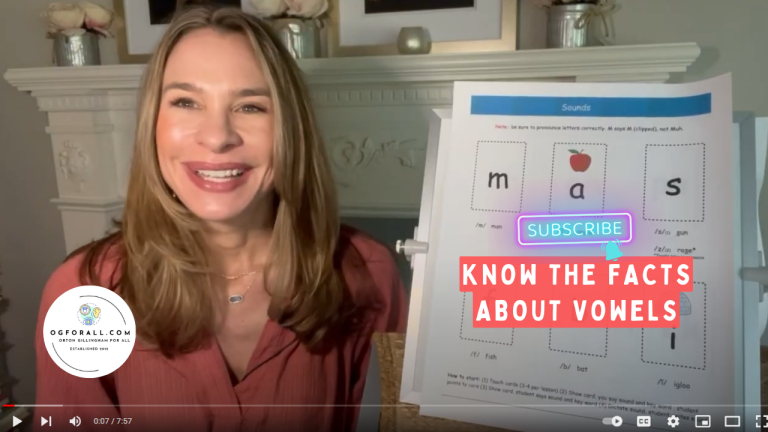
    What Do You Know About Vowels? You’ll Know More Now. Plus, Know the Vowel Decks! (VIDEO)

    Vowels and vowel sounds are the building blocks of the English language. Orton Gillingham is a phonics, rule-based approach to teaching and learning the English language. Using a scope and sequence makes it a cumulative, thorough approach to teaching English to both kids and adults. Orton Gillingham training teaches how to use multi-sensory learning to teach all of this and more.

    Read More What Do You Know About Vowels? You’ll Know More Now. Plus, Know the Vowel Decks! (VIDEO)Continue

  • How to Teach Vowel Team Syllables For the Best Outcome: A Science of Reading-Based Approach (With OG Strategies!)
    Types of Syllables

    How to Teach Vowel Team Syllables For the Best Outcome: A Science of Reading-Based Approach (With OG Strategies!)

    Vowel team syllables contain a vowel team and can appear within a word’s beginning, middle, or end. Recognizing these syllables aids students in breaking down and spelling words. The REVLOC system categorizes syllables by type, and teaching involves sorting and labeling exercises. Orton Gillingham’s approach enhances English learning.

    Read More How to Teach Vowel Team Syllables For the Best Outcome: A Science of Reading-Based Approach (With OG Strategies!)Continue

  • Vowel Teams Explained
    Consonants & Vowels | Featured | Vowel Teams

    Vowel Teams Explained

    Ever wondered why rain, boat, and light don’t follow the same vowel rules? That’s the magic (and challenge) of vowel teams — two or more letters working together to make one sound. Teaching them doesn’t have to be tricky. First, we introduce each team, their sounds, and the keywords that help students remember them. Then…

    Read More Vowel Teams ExplainedContinue

  • Consonants & Vowels

    A Simple Guide for Teaching Short Vowels Using Multi-Sensory

    If you’re teaching short vowels using the Orton Gillingham approach, this guide has some direction and ideas for you. Let’s walk through effective strategies to help your students not only understand short vowels but also retain and use their knowledge. Start with Phonemic Awareness Developing a student’s phonemic awareness and the ability to clearly hear…

    Read More A Simple Guide for Teaching Short Vowels Using Multi-SensoryContinue

  • Strategies for Encoding & Decoding (Video)
    Reading | Spelling Rules & Patterns | Videos

    Strategies for Encoding & Decoding (Video)

    If you’ve ever wondered how reading and writing really come together, it starts with encoding and decoding. These core skills are at the heart of Orton-Gillingham. In this video, I’ll walk you through the difference between the two, and show you engaging ways to practice them with your students. Teaching Encoding and Decoding (Video) The…

    Read More Strategies for Encoding & Decoding (Video)Continue

  • Help with b and d confusion, Strategies and Activities (Video)
    Consonants & Vowels | Teaching Tools & Strategies | Videos

    Help with b and d confusion, Strategies and Activities (Video)

    From Orton Gillingham Coaching (Video) Most tutors and teachers of Orton Gillingham have a student (or 10!) that confuse “b” and “d.”  It’s a common challenge for kids, but throw in a dyslexia diagnosis, and it gets even harder. There are several strategies to use to help students overcome this issue. Most tutors and teachers…

    Read More Help with b and d confusion, Strategies and Activities (Video)Continue

  • My Student Knows Letter Sounds But Struggles to Blend CVC Words
    Reading | Teaching Tools & Strategies

    My Student Knows Letter Sounds But Struggles to Blend CVC Words

    Practical ways to support CVC blending If a student knows their letter sounds but freezes when it’s time to read words, you’re not alone. This is one of the most common and frustrating early reading roadblocks for teachers, tutors, homeschool families, and parents. At first glance, it can seem simple: They know the sounds –…

    Read More My Student Knows Letter Sounds But Struggles to Blend CVC WordsContinue

  • From Isolated Sounds to Blending CVC (VIDEO)
    Consonants & Vowels | Reading | Videos

    From Isolated Sounds to Blending CVC (VIDEO)

    From Orton Gillingham Coaching In teaching with structured literacy, there are reasons it’s hard for students to go from isolated sounds to blending. It’s not just incomprehension, it has to do with moving from doing one task, making one sound, to now doing three things, blending three sounds. It’s a jump for younger kids and…

    Read More From Isolated Sounds to Blending CVC (VIDEO)Continue

Page navigation

1 2 Next PageNext
  • Home
  • Teaching Articles
  • Shop
  • Courses
  • Resources
  • Home Support
  • Start Here
Support OGforALL

© 2026 All Up Literacy Website Design by Christi Fultz

Review Cart

No products in the cart.

  • Teaching Articles
  • Start Here
  • Shop
    • Online Store
    • TPT Shop
    • Courses
    • My Account
    • Cart
  • Courses
  • Home Support
Search